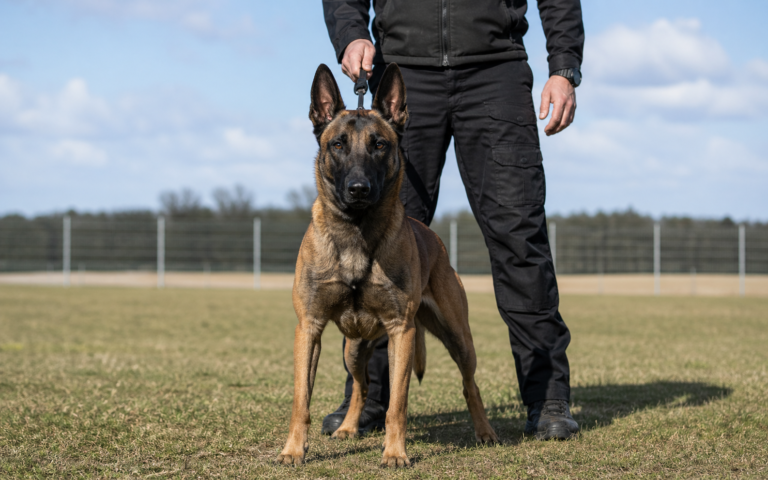
The levels of protection dogs describe how far a dog’s training has been taken, from obedience and deterrence at Level 1 through controlled engagement at Level 2 to handler-directed protection work at Level 3. There is no industry-wide standard behind these labels, which means two companies can sell very different dogs under the same number.
That matters more than most buyers realize. If you are comparing programs, you are comparing capabilities, not tiers. This guide explains what each level typically covers, what every level should share regardless of label, and how to work out which one your household actually needs.
Things to Know
- Protection dog levels are set by each company, not by any governing body
- Level 1 dogs deter and alert but are not trained to engage
- Level 2 adds controlled engagement with a reliable release on command
- Level 3 covers handler-directed work for high-exposure situations
- Full obedience and a dependable off switch should exist at every level
Also Read: Levels describe training depth, not the job the dog is meant to do. This guide to the types of protective dogs covers the different roles a working dog can fill.
What Protection Dog Training Levels Actually Mean
A training level is a shorthand for how much protection work a dog has completed on top of its obedience foundation. It is a useful comparison tool and a poor guarantee.
No certifying body defines Level 1, 2, or 3. Each company builds its own tier system and decides what belongs in each one. Some use numbers, some use names like Protector, Guardian, and Executive. The progression is broadly similar across the industry, but the details are not, and a Level 2 dog from one program may match another program’s Level 1.
This is why capability questions beat tier questions. Ask what the dog does on command, what it does without a command, how it releases, and how it behaves in a house full of guests. Those answers are comparable across companies. A number is not.
One thing should be true at every level: the dog is stable, social, and fully obedient before any protection work is layered on. Protection training does not fix temperament. It amplifies whatever is already there.
Level 1, 2 and 3 Compared
The table below shows the typical progression across the market. Use it as a framework for asking better questions rather than as a fixed standard.
| Capability | Level 1 | Level 2 | Level 3 |
|---|---|---|---|
| On and off leash obedience | Yes | Yes | Yes |
| Alert barking on command | Yes | Yes | Yes |
| Visible deterrence and posturing | Yes | Yes | Yes |
| Controlled engagement | No | Yes | Yes |
| Release on command | Not applicable | Yes | Yes |
| Handler-directed work at distance | No | Limited | Yes |
| Area and perimeter searching | No | Sometimes | Yes |
| Multiple-threat scenarios | No | No | Yes |
| Vehicle and travel work | No | Sometimes | Yes |
Notice that the obedience row never changes. That is the point. Every tier is built on the same foundation, and the difference between them is what has been added on top of it.
Level 1: Deterrence and Early Warning
A Level 1 protection dog is fully obedient, well socialized, and trained to alert and posture on command without ever being taught to engage.
In practice, that means a dog that walks calmly on a loose leash, holds a down-stay with guests in the house, and shifts into an alert, barking stance when you cue it. The deterrent effect is real. Most opportunistic intruders leave the moment a large, confident dog announces itself, and that resolution costs nothing and risks nobody.
Level 1 suits the majority of family buyers better than they expect. If your concern is a stranger at the door, a car break-in, or walking alone at night, presence and early warning solve most of it. These dogs are also the easiest to live with, since there is no engagement training to maintain and no scenario where a mistake becomes a bite.
Also Read: Deterrence works because a working dog reads a situation before you do. See what a protection dog does day to day in this breakdown of their role in safety and security.
Level 2: Controlled Engagement
A Level 2 dog does everything a Level 1 dog does and adds the ability to engage a genuine threat on command, then disengage completely when released.
The engagement itself is less important than the release. A dog that bites is common. A dog that stops instantly, returns to the handler, and settles is the product of serious training. That control is the entire difference between a protection dog and a dangerous one.
Level 2 dogs typically also hold position around the handler, guard on and off leash, and work in more varied environments than Level 1 dogs. They suit buyers in higher-risk areas, people who travel frequently, property owners, and households that want more than a visual deterrent.
The trade-off is maintenance. Engagement training needs periodic reinforcement with a professional, and everyone in the household needs to handle the dog consistently. A Level 2 dog in a home with inconsistent rules is a worse outcome than a Level 1 dog in a structured one.
Level 3: Executive and Specialized Work
Level 3 is the top civilian tier and covers handler-directed protection in complex, high-exposure situations.
These dogs work at distance on direction, conduct area and room searches, hold composure in crowds and public settings, work around vehicles, and handle scenarios involving more than one threat. They are selected from a much smaller pool of candidates, since very few dogs have the nerve strength to stay clear-headed under that kind of pressure.
Level 3 is genuinely unnecessary for most households, and any program pushing it as a default is selling rather than advising. It fits executives, public-facing individuals, business owners, and anyone whose exposure is ongoing rather than occasional.
Also Read: Higher levels demand more of the handler, not less. This guide on how to train a protection dog explains what structured, balanced work looks like day to day.
Choosing the Right Level for Your Household
Start with your actual exposure and your household’s ability to maintain the dog, not with the highest tier you can afford. Over-leveling is one of the most common and most expensive mistakes buyers make.
| Your Situation | Level That Usually Fits | Why |
|---|---|---|
| Family home, young children, average risk | Level 1 | Deterrence and obedience solve the realistic scenarios without engagement risk |
| Suburban home, occasional concern about intrusion | Level 1 to Level 2 | Presence plus the option of controlled response |
| Large property or estate grounds | Level 2 | Perimeter awareness and confidence working away from the house |
| Business premises with staff and customers | Level 2 to Level 3 | Neutrality around people plus handler-directed control |
| Public figure or frequent traveler | Level 3 | Composure in crowds, vehicle work, discreet handling |
At K9 Mania Protection Dogs, candidates are drawn from the top percentage on temperament, intelligence, and natural protective instinct, and every dog is proofed in real-life scenarios before placement rather than only in training environments. Dogs are trained to live as family members first and guardians second, which is why the same stability requirement applies at every level. You can see the family protection dogs currently available and the level each has been trained to. If your needs do not map neatly onto a standard tier, the custom protection dogs program matches the dog to the specific role instead.
Choosing Among the Levels of Protection Dogs With Confidence
The levels of protection dogs are a useful map, not a ranking to climb. A Level 1 dog placed in the right home does more good than a Level 3 dog in a household that cannot maintain it, and the best programs will tell you that plainly rather than upsell you.
Before you commit, ask to watch the dog work, ask specifically about the release, and ask what maintenance the level you are considering requires from you. If a company cannot answer those clearly, the tier label is not worth much.
If you want help working out which level genuinely fits your household, contact K9 Mania Protection Dogs and talk it through before you look at available dogs.
Frequently Asked Questions About the Levels of Protection Dogs
Is there an official standard for protection dog levels?
No. There is no governing body that defines Level 1, 2, or 3, and each company sets its own tiers and criteria. That means the same label can describe meaningfully different dogs depending on who trained them. The practical fix is to ask capability questions instead of tier questions: what does the dog do on command, how reliably does it release, and how does it behave around guests and children.
What level of protection dog do most families need?
Most families are best served by a Level 1 or lower Level 2 dog. The realistic threats a household faces, opportunistic intrusion, a stranger at the door, or being approached while out walking, are resolved by presence, alert barking, and obedience. Engagement training adds capability but also adds maintenance and responsibility, and it is worth taking only if your actual exposure justifies it.
Can a Level 1 dog be upgraded later?
Sometimes, but it depends on the dog. Moving up a level requires the temperament and nerve strength to handle engagement work, and not every Level 1 dog has it. A good program will evaluate the individual dog honestly rather than promising an upgrade path as a sales point. Ask about this before purchase if it matters to you.
Are higher-level protection dogs more dangerous?
Not when they are properly trained. A higher-level dog has more trained capability, but it also has more control work behind it, including a reliable release and a strong off switch. Risk comes from unstable temperament and inconsistent handling, not from training level. A poorly managed Level 1 dog is more of a concern than a well-managed Level 3 dog. You can read more about how controlled behavior differs from reactivity in this guide on protection dog aggression.
How long does it take to train a dog to each level?
Foundation obedience and Level 1 work typically take many months of consistent daily training. Level 2 usually pushes total development past the eighteen-month mark, and Level 3 dogs are often two to three years in before placement. Timelines vary by the individual dog, since a candidate that struggles at any stage should not be pushed forward on schedule alone.
Do protection dogs at every level live normally at home?
Yes, and that is the standard to hold any program to. Regardless of level, a properly trained protection dog should be calm indoors, social with family and invited guests, and completely relaxed when nothing is happening. A dog that stays tense at home is not a higher-level dog, it is a poorly balanced one.
Understanding the Levels of Protection Dogs With K9 Mania
K9 Mania Protection Dogs is a Long Island based company placing elite personal and family protection dogs with households nationwide. Dogs are hand-selected for temperament, proofed in real-world conditions, and trained to integrate into home life at every training level, with free lifetime post-delivery support included in every placement. To talk through which level fits your situation, visit k9maniaprotectiondogs.com.