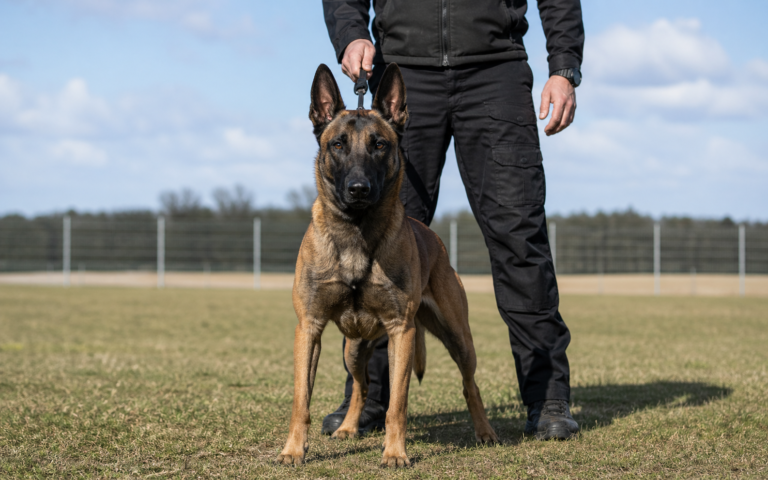
A guard dog deters and alerts based largely on natural territorial instinct, while a protection dog is professionally trained to assess a situation, respond on the handler’s direction, and stand down completely on command. The difference is control: a guard dog reacts, a protection dog is directed.
That single distinction changes everything about how the two dogs live in a home, what they cost, and what they can safely be trusted to do. If you are trying to work out which one you actually want, this guide covers what each term means, how they compare in practice, and which fits which household.
Things to Know
- Guard dogs rely on instinct and territory; protection dogs rely on training and cues
- The release, not the response, is what separates the two
- Any breed can guard, but very few individual dogs are suited to protection work
- Guard dogs are territory-bound, protection dogs travel with the handler
- A protection dog should be calm and social at home until directed otherwise
Also Read: The terminology gets used loosely across the industry. This guide to the types of protective dogs sorts out the different roles a working dog can fill.
What Is a Guard Dog?
A guard dog is a dog that protects a place. Its job is territorial: watch the property, notice what does not belong, and make noise about it.
Most guard dogs do this on natural instinct rather than formal protection training. Breeds with strong territorial drive will bark at unfamiliar people, patrol a fence line, and position themselves between the house and a stranger without anyone teaching them to. Basic obedience helps, but the underlying behavior is temperamental rather than trained.
That has real limits. A guard dog’s judgment is its own. It decides what counts as a threat, and it does not distinguish reliably between an intruder, a delivery driver, a contractor, and your neighbor’s teenager retrieving a ball. It also has no formal release, which means once it commits to a response, you are relying on recall and hope rather than trained control.
Guard dogs work well for their actual purpose: warning you that something is happening on your property. They are a poor fit for households with steady foot traffic, young children, or frequent guests.
What Is a Protection Dog?
A protection dog protects people. It works with a handler, responds to cues, and disengages completely when told to.
Everything sits on an obedience foundation. Before any protection work begins, the dog is fully obedient on and off leash, socialized to crowds, traffic, elevators, guests, and unfamiliar surfaces, and evaluated for stable temperament under pressure. Only after that does protection training get layered on, and only for dogs that pass.
The trained behavior is specific and cue-based. The dog alerts on command, holds position, escalates or de-escalates on direction, and releases instantly. Between those moments it is a normal dog: relaxed indoors, friendly with people you introduce, and completely uninterested in the mail carrier.
That is the part buyers find hardest to believe. A well-trained protection dog is not permanently switched on. Protection is a trained response it can enter and leave, not a personality it wears all day.
Also Read: Controlled response is often mistaken for aggression. This guide on protection dog aggression explains where the line actually sits.
Guard Dog vs Protection Dog: Side by Side
| Factor | Guard Dog | Protection Dog |
|---|---|---|
| Primary job | Protects property | Protects people |
| Trigger | Own judgment, territorial instinct | Handler cue or genuine threat |
| Training basis | Instinct plus basic obedience | Structured protection work on a full obedience foundation |
| Release | Recall at best, often unreliable | Trained, immediate, on command |
| Range | Tied to the property | Travels with the handler |
| Around guests | Often tense or reactive | Calm once introduced |
| Selection | Most dogs of a guarding breed | A small percentage of candidates |
| Suitable for children | Depends heavily on the individual dog | Assessed and proofed before placement |
The rows that matter most are release and selection. A dog that cannot be called off is a legal and physical liability regardless of how effective it looks, and a dog that was never assessed for temperament should not be doing protection work at all.
Where the Confusion Comes From
Three things keep these terms tangled, and all three cost buyers money.
The words are used interchangeably in marketing. Plenty of sellers advertise guard dogs and protection dogs as the same product because both phrases get searched. Read the capability description, not the headline.
Breed gets mistaken for training. A German Shepherd is not a protection dog because it is a German Shepherd. Breed influences suitability, but the individual dog’s nerve strength and the training behind it determine whether it can actually do the work. Any breed can guard. Very few individual dogs are cut out for protection work.
Sport-trained dogs get sold as protection dogs. A dog trained for bite sports works on equipment in a predictable format. That is impressive and it is not the same as a dog proofed against real, unscripted scenarios. Ask specifically how the dog has been tested outside a training field.
There is also a third term worth separating out. A watchdog simply alerts. It may be small, it may have no capacity to do anything beyond bark, and for plenty of households that is genuinely enough.
Which One Actually Fits Your Situation
Most buyers who say they want a guard dog describe a situation that calls for a protection dog, and a smaller number who ask for protection dogs would be well served by a good family dog with strong obedience. Match the dog to the actual problem.
| Your Situation | Better Fit | Why |
|---|---|---|
| Fenced property, minimal visitors, want intrusion warning | Guard dog or watchdog | Territorial alerting solves it without engagement risk |
| Family home with children and regular guests | Protection dog | Trained control and assessed temperament are non-negotiable around traffic |
| Concerned about personal safety away from home | Protection dog | A property-bound dog is no help on a street or in a parking lot |
| Business premises with staff and customers | Protection dog | Neutrality around people plus handler direction |
| Large rural property, livestock present | Livestock guardian breed | A different job entirely, requiring different instincts |
At K9 Mania Protection Dogs, dogs are selected from the top percentage of candidates on temperament and natural protective instinct, then proofed in real-life scenarios before they are ever placed. They are trained to be family members first and guardians second, which is why they settle in a home rather than patrol it. Every placement includes free lifetime post-delivery support and hands-on handover so you can actually direct the dog from day one. You can see the current family protection dogs available or read through the selection process behind them.
Guard Dog vs Protection Dog: Making the Right Call for Your Home
The guard dog vs protection dog question comes down to whether you need a property watched or a family protected, and whether you need a dog that decides for itself or one that answers to you. For most households with children, guests, and a life outside the front gate, trained control is worth more than territorial instinct.
Whichever direction you lean, insist on seeing the dog work and ask directly about the release. A dog that engages is easy to find. A dog that stops on command, every time, is the one worth paying for.
If you want help working out which fits your household, contact K9 Mania Protection Dogs and start with your situation rather than a breed.
Frequently Asked Questions About Guard Dogs vs Protection Dogs
Is a guard dog the same as a protection dog?
No. A guard dog protects a place using its own territorial instincts, while a protection dog protects people and responds to handler cues with a trained, reliable release. The terms are used interchangeably in marketing, but the dogs are meaningfully different in training, control, and where they can be trusted. The release on command is the clearest practical dividing line between them.
Can a family pet become a protection dog?
Only if the individual dog has the temperament for it, and most do not. Protection work requires nerve strength, confidence under pressure, and emotional stability, and no amount of training creates those traits if they are not already present. A proper program evaluates the dog first and declines candidates that are unsuitable, because pushing an unsuitable dog into protection work produces an unpredictable animal rather than a capable one.
Which is better for a family with children?
A properly trained protection dog, provided it has been assessed and proofed for stable temperament before placement. Protection dogs are trained to distinguish between family, invited guests, and genuine threats, and they are conditioned to stay calm and social at home. A guard dog operating on instinct has no such training, which makes it harder to trust around children’s friends, visitors, and regular household traffic. You can read more in this guide on whether protection dogs are safe around children and other pets.
Do guard dogs need professional training?
They benefit enormously from obedience training even if they never do protection work. A guard dog with reliable recall, a solid down-stay, and a workable leave-it command is far safer and far more useful than one operating purely on instinct. Professional training also helps identify whether the dog’s guarding behavior is confident or fear-based, which matters a great deal for how it should be managed.
What is the difference between a watchdog and a guard dog?
A watchdog alerts and nothing more. It notices something unusual and barks, which is genuinely useful and requires no size or physical capability at all. A guard dog alerts and is willing to physically hold ground or confront an intruder. Many households that think they need a guard dog are actually well served by a reliable watchdog and a decent alarm system.
Which breeds make the best protection dogs?
German Shepherds and Belgian Malinois dominate professional protection work because of their trainability, drive, and nerve strength, with Dutch Shepherds, Dobermans, Rottweilers, Cane Corsos, and Giant Schnauzers also used. Breed narrows the field but does not decide it. Within any of those breeds, only a small percentage of individual dogs have the temperament to do the work safely, which is why selection matters more than breed choice.
Guard Dog vs Protection Dog: Get Straight Answers From K9 Mania
K9 Mania Protection Dogs is a Long Island based company placing elite personal and family protection dogs with households across the country. Every dog is hand-selected for temperament, proofed in real conditions, and trained to live as part of the family rather than patrol its perimeter, with free lifetime post-delivery support included. To talk through what your household actually needs, visit k9maniaprotectiondogs.com.